A full syringe of filler for a suspiciously low price may sound like an amazing deal.
But before you let anyone inject it into your face, there is a much more important question to ask:
What exactly is inside that syringe?
Counterfeit, illegally imported, and non-FDA-approved injectables are not just something that happens in another country or in stories on social media. Unapproved products can (and do!) make their way into local markets.
At GOTOX Aesthetics & Wellness, we believe you deserve to know exactly what is being injected, where it came from, and whether it has been reviewed for safety in the United States.
What Is Fake or Unapproved Dermal Filler?
“Fake filler” is a broad phrase people use to describe several different problems:
- A counterfeit product designed to imitate an established filler brand
- A filler that may be legitimate in another country but is not FDA-approved for use in the United States
- A product purchased through an unauthorized supplier
- A syringe that has been tampered with, improperly stored, contaminated, or relabeled
- A substance being presented as hyaluronic-acid filler when its contents cannot be verified
These are not all technically the same thing, but they have one dangerous quality in common: you do not know whether or not the product has gone through the proper U.S. safety, manufacturing, storage, and distribution process.
The FDA specifically warns consumers not to purchase filler sold directly to the public because it may be counterfeit, contaminated, or unapproved. But at Gotox, we hear the stories of women being injected with these fillers or even injecting themselves.
FDA-approved fillers are prescription medical devices and should be administered by appropriately licensed healthcare professionals. (FDA)
Is It Safe if the Product Contains Hyaluronic Acid?
Not necessarily.
Hyaluronic acid is a substance naturally found in the body, and many well-known FDA-approved fillers are made with hyaluronic acid. But the words “hyaluronic acid” on a box do not automatically make a product safe.
The source, concentration, cross-linking technology, manufacturing environment, sterility, packaging, storage, and quality controls all matter. With an unapproved or counterfeit product, you may not know:
- Whether it contains the ingredients listed on the package
- Whether it was manufactured under appropriate sterile conditions
- Whether it was stored at the correct temperature
- Whether it has been diluted or altered
- Whether it contains contaminants
- How the product will behave once it is injected
- Whether it can be safely dissolved if a complication occurs
Simply put, “It’s just hyaluronic acid” is not a sufficient answer when the product is being placed beneath your skin.
Does Dermal Filler Go Away?
Many FDA-approved hyaluronic-acid fillers are considered temporary and gradually break down over time. Depending on the product, treatment area, amount injected, and individual patient, the results may last months or longer.
But filler does not necessarily disappear on the same predictable timeline as a wrinkle-relaxing treatment.
Botox and other approved neuromodulators temporarily reduce muscle activity, and their cosmetic effects generally wear off as nerve signaling returns. Filler physically adds material beneath the skin. It may remain in the tissue longer than a patient expects, migrate from the original treatment area, or require professional evaluation and treatment if complications develop.
When the filler is authentic hyaluronic acid, an experienced medical provider may be able to dissolve it with hyaluronidase when medically appropriate. If the injected product is counterfeit, contaminated, or made from an unknown substance, the provider may not know how it will respond.
That is why knowing the product before it enters your face is so important.
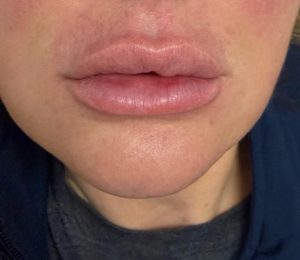
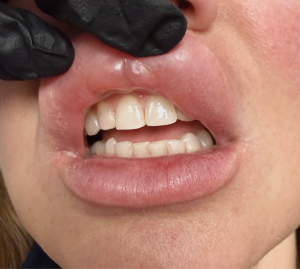
Here is a patient who came to us after receiving unapproved filler:
Why Is Unapproved Filler Dangerous?
Even authentic, FDA-approved dermal filler comes with medical risks. Common reactions can include swelling, bruising, redness, pain, and tenderness. Less common complications include infection, nodules, open wounds, tissue damage, and allergic or inflammatory reactions.
One of the most serious filler complications is vascular occlusion. This happens when filler enters or compresses a blood vessel and restricts blood flow. It can result in skin injury, tissue death, vision loss, stroke, or other serious harm. The FDA explains that accidental injection into a blood vessel is the most serious risk associated with dermal filler. (FDA)
An unapproved or unknown product introduces even more uncertainty. If a complication occurs, your medical provider may not know precisely what was injected, how the material behaves, or which treatment will be effective.
This is not about whether a product was made in the United States, Korea, or another country. Many excellent medical products are manufactured worldwide. The concern is whether the exact product is FDA-approved for its intended use in the United States and obtained through an authorized supply chain.
A product being approved or popular in another country does not automatically make it approved for injection in the United States.
How Can You Tell if Your Filler Is Real?
You have every right to ask questions before your treatment. A trustworthy injector should welcome them.
1. Ask for the exact product name
Do not settle for “It’s hyaluronic acid” or “It’s the same thing as JUVÉDERM.” Ask for the brand, product line, and exact filler being recommended.
Different fillers are created for different areas and purposes. Your provider should be able to explain why that specific product is appropriate for you.
2. Ask to see the box
Your injector should be willing to show you the original, sealed product packaging. Look for the product name, manufacturer, lot number, expiration date, and intact safety seals.
Ideally, you should see the packaging before the syringe is opened.
Seeing a box is not a perfect guarantee because packaging can also be counterfeited, but resistance to showing it should be a major red flag.
3. Confirm that the product is FDA-approved
The FDA maintains a list of dermal fillers approved for specific uses in the United States. You can search the FDA-approved dermal filler list or ask the practice to show you the product’s approval information.
Be aware that even familiar brand names can have versions sold in other countries that are not approved in the United States. The FDA specifically warns against using unapproved versions such as JUVÉDERM Ultra 2, 3, and 4 in the U.S.
4. Ask where the practice purchases its products
Authentic injectables should come directly from the manufacturer or an authorized U.S. distributor—not an online marketplace, overseas discount website, or unknown third party.
Your provider should be able to confidently explain how the practice sources and stores its products.
5. Look for legitimate manufacturer programs
Participation in an established manufacturer’s patient-rewards or partnership program can provide another layer of reassurance that the practice has a relationship with an authorized brand.
However, a rewards program alone does not guarantee that every product is authentic. It should be considered alongside the provider’s licensing, training, sourcing practices, packaging, and transparency.
6. Verify the injector’s license and qualifications
In Michigan, you can verify a healthcare professional’s license through the state’s Licensing and Regulatory Affairs website.
Also ask:
- What medical license do you hold?
- How much experience do you have with this treatment?
- What training have you completed?
- How do you recognize and manage vascular occlusion?
- Do you keep hyaluronidase and emergency supplies available?
- Who should I contact if I experience a problem after treatment?
The product matters, but the person holding the syringe matters just as much.
Is a Very Low Price a Warning Sign?
It can be.
Pricing alone cannot prove that a product is fake. Practices may offer limited promotions, membership pricing, or manufacturer-supported events. But injectables have real costs associated with authentic products, trained medical providers, proper storage, clinical supplies, insurance, and emergency preparedness.
If you see Botox or another neuromodulator advertised for around $8 per unit—or a full syringe of filler for approximately $500 or less—pause and ask questions.
A dramatically low price should never be the only reason you select an injector. Ask:
- What exact brand and product will be used?
- Is it FDA-approved in the United States?
- May I see the unopened box?
- Where was it purchased?
- Who will perform my injections?
- What happens if I experience a complication?
A deal is not a deal if you do not know what is being placed into your body.
What Are the Red Flags of Potentially Unsafe Filler?
Be cautious if:
- The provider refuses to name the product
- You are not allowed to see the packaging
- The syringe is already open or prepared before you arrive
- The product is not listed among FDA-approved fillers
- The injector says an overseas product is “basically the same”
- The treatment is being performed in a home, hotel room, party, or other nonclinical environment
- The price seems unusually low without a clear explanation
- The provider cannot explain how complications are handled
- You feel pressured to make a fast decision
- There is no consultation, medical history, consent process, or follow-up plan
Trust your instincts. If the answers are vague or something does not feel right, you are allowed to leave.
What Should You Do if You Think You Received Fake Filler?
Contact a qualified medical provider promptly and share as much information as possible, including the name of the product, provider, treatment date, injection areas, receipt, photographs, and any packaging information.
Seek immediate medical care if you experience:
- Severe or increasing pain
- Skin that becomes pale, gray, blue, blotchy, or unusually dark
- Coolness near the treatment area
- Blisters or open skin
- Sudden vision changes
- Severe headache
- Weakness, confusion, or other neurological symptoms
- Difficulty breathing or swallowing
- Rapidly worsening swelling
Do not wait for serious symptoms to “settle down.” Some filler complications are time-sensitive.
Suspected product problems and adverse events can also be reported through the FDA’s MedWatch program.
The Bottom Line: You Deserve to Know What Is in the Syringe
Filler is a medical procedure, not just a simply a beauty purchase.
You should never feel awkward asking to see the box, verify the product, review your injector’s credentials, or question a price that seems too good to be true. A reputable medical aesthetics practice will appreciate that you care about your safety.
At GOTOX Aesthetics & Wellness, we believe informed patients make confident decisions. We are committed to product transparency, responsible sourcing, continuing education, and treatment plans based on your individual needs—not the cheapest syringe available.
Have questions about filler safety or want to know which treatment may be right for you? Schedule a consultation with our team. We will walk you through the product, the process, the possible risks, and what you can realistically expect before you decide.
Schedule your appointment HERE
This article is for general educational purposes and does not replace personalized medical advice, diagnosis, or treatment. Contact a qualified healthcare professional about your individual needs. If you experience severe pain, skin-color changes, vision changes, or neurological symptoms after filler, seek immediate medical care.